


48 HOURS IN BUENOS AIRES
Sleep Can Wait
Paris of Latin America. World capital of football. Amazing steaks. Tango bars on every other street corner. Some clichés are unoriginal. And then there are clichés that are simply accurate. Argentina’s capital belongs firmly in the second category.
B uenos Aires has few traditional tourist attractions. There’s no Eiffel Tower, no Prado Museum, no Sydney Harbour Bridge and no Times Square — and the Torre Monumental is merely a pale imitation of London’s Big Ben. Buenos Aires is different. It’s a city you have to experience to even begin to understand it.
Sixteen million on the Río de la Plata
Argentina’s largest metropolis and the second-largest urban area in South America sits on the western shore of the Río de la Plata, a foul-smelling river ranking among the most polluted in the world. The district, granted autonomy in 1994, covers 3,800 square kilometres and is home to an estimated sixteen million people — more than a third of Argentina’s population.
Locals call themselves “Porteños,” derived from “puerto,” the port. What makes them proud is the international heritage of their fellow residents: over the decades, people from every continent have arrived here and made this their new home. That diversity shows in the distinctly multicultural cuisine of the capital.
A culinary world tour
If you love variety in your meals, Buenos Aires is the right place. The city’s restaurants reflect the cultural backgrounds of its immigrants. From Korean kimchi and a German farmer’s breakfast to homemade Italian pasta, from Japanese ramen to Armenian lamajoun, from Spanish bean stew to Peruvian ceviche — the options are endless.
Meat nonetheless remains a staple. Steaks are a local speciality, and steakhouses seem to be on every street corner, with cuts ranging from bife de chorizo to vacio and ojo de bife. When time is short, locals turn to choripán, an Argentine take on the hotdog: a chorizo sausage in a baguette with vegetables and flavourful chimichurri salsa. Also delicious are empanadas, fried pastry pockets with all kinds of fillings. And locro, a hearty stew of pumpkin and corn with chorizo, bacon or offal, is something Argentinians especially enjoy during the colder months.
For those with a sweet tooth, dulce de leche is a must-try. This thick caramel cream is used in countless desserts but can also be spread on bread.

Avenida 9 de Julio
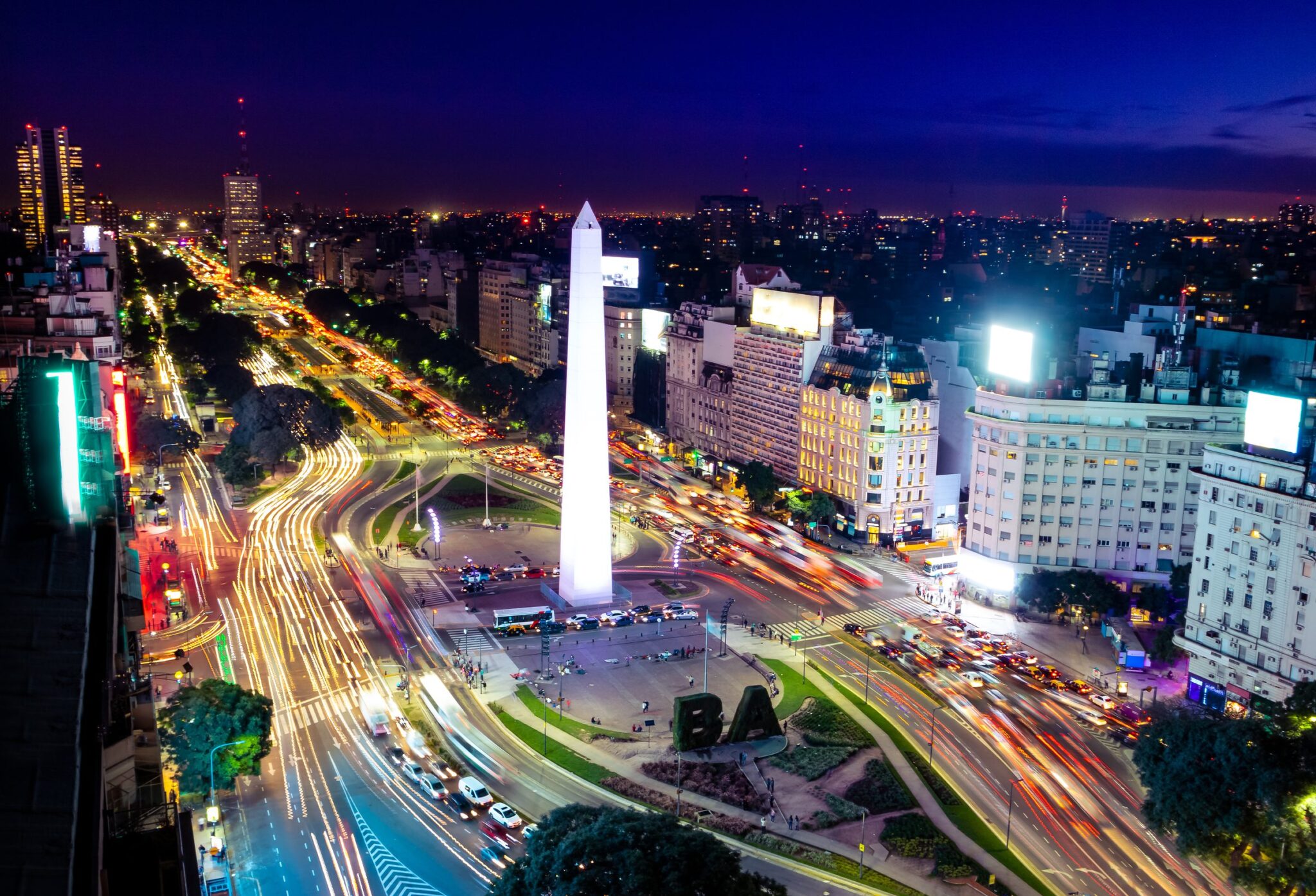
The monumental dimensions of Avenida 9 de Julio are impressive. Flanked by tree-lined medians, it carries ten lanes of traffic on either side. Until 1960 it was the world’s widest street, stretching 140 metres across. Among its architectural highlights is the famous Obelisk, with an observation deck 67 metres up.
Also located along this vast stretch of asphalt is the Teatro Colón. Built in 1908, the opera house is renowned for its unique acoustics. Caruso and Maria Callas have sung here, Strauss and Stravinsky have conducted the orchestras. In 1950 Daniel Barenboim, the Argentine-Israeli pianist and world-class conductor, gave his very first concert here at just seven years old.
With a view: Palacio Barolo
Buenos Aires is an endless sea of buildings, and the best way to make sense of its canyons of streets is from above. Palacio Barolo in the Montserrat neighbourhood was, at 100 metres and 22 storeys, the city’s tallest structure when it was completed in 1923. From the top floor the view runs along Avenida de Mayo and across Plaza del Congreso to the parliament building with its imposing green dome. Tours even take you up to the roof.

La Boca: colour, tango and football
The port district of La Boca is one of 48 barrios in Buenos Aires and synonymous with both tango and football. The colourful corrugated-iron houses lining the Caminito alley are among the most photographed sights in the Argentine capital.
La Boca — meaning “the mouth” — was founded at the end of the 19th century by immigrants, poor and mostly young men from Italy and Spain looking for a better life on the new continent. Many worked as day labourers at the port. Their homes were makeshift wooden shacks and corrugated iron houses, which they gradually brightened with discarded planks, boards and leftover paint from the shipyards. Today many of these houses have been renovated and are more vibrant than ever.
The neighbourhood is home to the most important pitch in all of Argentina. The Boca Juniors stadium goes by the nickname La Bombonera, the chocolate box. In this arena a young Diego Armando Maradona once dazzled the crowds; football-mad Argentina keeps him as a bronze statue. La Boca remains one of the poorer parts of the city: leave valuables at the hotel, and avoid deserted side streets and visits after dark.
A sad thought you can dance to
Tango is Argentina’s expression of passion, melancholy and pain. It originated in La Boca in the mid-19th century, initially a cheerful dance combining African, Creole and Spanish elements. In its early days it had a seedy reputation, with the music spreading through the brothels and slums of the city.
The mass immigration waves of the late 19th century flooded Buenos Aires with new arrivals. Italians in particular hoped to find their fortune in what they believed was a wealthy Argentina; by the turn of the century, more Italians lived in the city than native Argentinians. Buenos Aires couldn’t handle the influx, and soon immigrants were being turned away. No work, no status, too few women: many of the newcomers slipped into crime and sought escape in gambling dens, brothels — and music. Only on the dance floor could these men appear fearless and strong, and also lonely and sad. Cheerfulness had given way to melancholy. Enrique Santos Discépolo, one of the greatest figures of Argentine tango, is said to have called tango a sad thought you can dance to.
Only after tango had begun its global triumph in Paris did it become socially acceptable in Argentina, at the beginning of the 20th century. Dance cafés and tango theatres inspired by French models emerged, and tango orchestras even accompanied silent films in cinemas. Today the options range from glamorous shows to tango restaurants, milongas and dance schools — you can watch, or perfect your own steps.

Where books go to the theatre
The Argentine capital is a paradise for lovers of printed books. Practically every barrio has its own small bookshops, many with a café where Porteños stop to read and relax. The crown jewel is undoubtedly the magnificent El Ateneo Grand Splendid, a former theatre built in 1919. Where the stage once stood there is now a café; the old balconies hold comfortable armchairs for visitors to retreat into with a book. A fresco from the building’s construction, depicting the armistice that ended the First World War, still adorns the ceiling. The Guardian once named El Ateneo the second-most beautiful bookstore in the world.
Mercado de San Telmo
San Telmo was once a wealthy residential neighbourhood. When a yellow fever epidemic drove the affluent residents to the northern part of the city in 1871, immigrants took over the grand houses with their well-kept courtyards. The market, with its typically Italian façade, was built in 1897 to meet the needs of these new European arrivals.
Antiques, crafts and century-old toys, coffee from Papua New Guinea, spices from around the world, Patagonian empanadas or Taiwanese mangoes — the hall has it all. Coffee Town is reputed to serve the city’s best coffee. Some stalls have been modernised, but the structure with its metal columns and beams remains the same, creating a sense of stepping back in time. In 2000 the Mercado was declared a national historic monument.

El Cementerio de la Recoleta
In the upscale Recoleta district, the cemetery of the same name is the final resting place for prominent figures and members of Argentina’s elite. It holds roughly 7,000 opulent mausoleums, each contributing to the grand theatrical backdrop of this city of the dead. Eva Perón is buried here, the legendary wife of former president Juan Perón. When she died in 1952 she was undoubtedly the second most powerful person in Argentina, revered by the working class despite holding no official position in her husband’s government.
Established at the end of the 19th century, the cemetery spans more than five hectares and boasts magnificent tombstones, monumental mausoleums and a snow-white church at its centre. La Recoleta also serves as a graceful green space, used by locals and visitors alike as a quiet refuge from the hustle of the metropolis.
Palermo — the city’s hippest neighbourhood
If you travel to Buenos Aires and don’t visit Palermo, you haven’t truly been to the Argentine capital. Once home to the city’s bohemian crowd, it is now the trendiest area in town — and each of its four parts is worth exploring.
Old Palermo, Palermo Viejo, is full of stylish restaurants, though many are too expensive for locals, alongside hip bars, boutiques and the Dorrego antique and flea market. Palermo Hollywood is the northern part, named for its concentration of TV studios and production companies — and known for nightlife that continues until dawn. In Palermo Soho, creative designers live, work and sell their products. For a quieter atmosphere, head to Plaza Italia and the Bosques de Palermo, a 25-hectare city park famous for its groves and lakes; a stroll through the rose garden El Rosedal fills your senses with the fragrance of its blooms.
Palermo still counts as one of the most beautiful parts of the city. But a hungry building boom and the appetite of real estate speculators have reached it too: more and more of its small, historic houses are being bought up and torn down to make room for soulless concrete towers. For now, though, cars still move slowly over the cobblestone streets, and low Spanish colonial houses stand where anonymous blocks might have been.

When the people of Buenos Aires sleep is anyone’s guess: they eat late and then go dancing. Yet unlike the country’s rural inland areas, there’s no tradition of siesta in the capital. Which makes it all the easier to experience the essence of this city in just 48 hours.
Further information
Best time to visit — Spring from March to May or autumn from September to November, when daytime temperatures range between 20 and 26 degrees Celsius. The Argentine summer from December to February can be uncomfortably hot for Europeans. In spring, jacaranda trees turn the city into a sea of purple flowers.
Where to stay — Home Hotel Buenos Aires in Palermo: a trendy 20-room boutique hotel with an untamed garden, a swimming pool and a natural spa in the quiet backyard. No glossy anonymity, but a home away from home. homebuenosaires.com
Where to eat — Cabaña las Lilas in the harbour district of Puerto Madero is a parrilla, but stands out for its high-quality dishes and impeccable service. Following the “farm to table” principle, the meat comes from its own grass-fed cattle. To show how tender it is, the waiters cut each steak at the table with a spoon. restaurantlaslilas.com.ar
Words: Matthias Reimann