



NOVA SCOTIA & PRINCE EDWARD ISLAND
In the Rhythm of the Tides
Our first trip to Canada. The Rocky Mountains, maple syrup, hockey, Niagara Falls — so many images run through our heads as we head for Halifax. What awaits us over the next ten days is a different Canada: rugged coastlines, gentle landscapes and a sea that disappears twice a day.
T he capital of Nova Scotia is a harbour city through and through. The Atlantic isn’t just a backdrop, it sets the pulse. Along the waterfront, ferries line up beside fishing boats, while monuments recall fearless sailors and war heroes. In between, the food stalls smell like the world, fresh lobster next to spicy curry. And where warehouses once stood, glass facades now mirror themselves in the water.
Halifax: history along the pier
The best way to take in the harbour’s bustle is from the water — and yes, fully electric. A small launch in 1930s style glides quietly along the waterfront, past Georges Island and under the Angus L. Macdonald Bridge.
At the Canadian Museum of Immigration at Pier 21 we step into another era. Suitcases with worn leather handles, yellowed documents, children’s drawings — every object carries the courage and uncertainty of the people who arrived here. Roughly a million newcomers passed through between 1928 and 1971. For many it was a fresh start, for others the last stop after flight and war.
Not far from the harbour, Fairview Lawn Cemetery marks another tragic chapter: more than 150 Titanic victims are buried here. Halifax was the nearest major port when the disaster struck. Only a few years later the city became the scene of yet another catastrophe — the Halifax Explosion of 1917, the largest human-made blast before the atomic age, killed nearly 2,000 people.
As we leave the museum, a cannon crack jolts us: the traditional Noon Gun has fired every day at exactly 12:00 since 1857. In the evening, a pub with live music, a classic blues singer alone on stage with a donation bucket in front of him — and a classic poutine: fries topped with squeaky cheese curds and smothered in brown gravy.

Peggy’s Cove: Canada’s most famous lighthouse
“Now this looks properly Canadian,” I scribble in my notebook. Mixed forests, quiet lakes and moody bog landscapes accompany us around Nova Scotia. Our first stop is Peggy’s Cove, the fishing village with what may be the most famous lighthouse in the country. Since 1915 the tower has been both navigation aid and symbol of the Atlantic coast’s rough beauty. Smooth granite boulders, polished by waves over millennia, form a landscape that feels elemental.

When the sea swallowed 229 people
Barely a kilometre away stands a memorial that reminds us how unforgiving the ocean can be: the monument to the victims of Swissair Flight 111. On 2 September 1998 the aircraft en route from New York to Geneva crashed into the sea off Peggy’s Cove. All 229 people on board were lost.
Gerry, who runs a souvenir shop in the village, still remembers the day in vivid detail: “It was unbelievable. Suddenly, the whole area was lit up at night. Police, fire crews, rescue vehicles. For a week, it was a state of emergency. Even the local fishermen weren’t allowed out. The whole village was in shock. Early September, no tourists. Just nothing. It was very traumatic.”

The Lighthouse Route: coastal calm, one village at a time
The encounter at the memorial leaves us quiet. But the coastline keeps pulling us on. We skip the highway and take the slower Lighthouse Route along the shore. Our first stop is a French bakery somewhere in the middle of nowhere: excellent coffee, croissants that could pass in Paris, and people so disarmingly friendly and chatty you wonder if that’s the real national treasure of Canada.
Tonight we stay in Argyle, at the Argyler Lodge. A cabin right on Lobster Bay delivers peak Canada. Dinner seals the day: fresh scallops, which alongside lobster and oysters are one of Nova Scotia’s signature specialities.
Annapolis Valley: Nova Scotia’s fertile heart
Sticking to the coast brings us to the Bay of Fundy and into the Annapolis Valley, Nova Scotia’s breadbasket. Apples, wild blueberries, pumpkins, wine, all kinds of vegetables — the valley is blessed with abundance. Typical here are the many farmers’ markets, like our farm shops back home, only in XL.
As wine lovers, we can’t resist one of the region’s wineries. We choose Grand Pré, widely regarded as Atlantic Canada’s oldest farm winery — and to our surprise it’s Swiss-owned. Founded in 1994 by former banker Hanspeter Stutz, it was developed with his family into a thriving operation with a wine shop, restaurant and small inn. Around 20 hectares are under vine, with a broad range of varieties from L’Acadie Blanc and Chardonnay to Riesling and Pinot Noir.

Spectacle on the Bay of Fundy
The Annapolis Valley owes much of its richness to its location on the Bay of Fundy. But this bay has a far more dramatic side. The number-one topic here is the tidal range, the difference between low and high tide. Nowhere on earth is it greater: the water rises by about 13 metres on average, and up to 16 at spring tide. The bay is long, narrow and funnel-shaped, compressing the incoming water and amplifying the tidal surge.
Armed with the tide table, we head to Hall’s Harbour, a small fishing village known for its photogenic harbour and the Lobster Pound, a restaurant right by the sea. When we arrive at 8 a.m., the water level in the harbour is around 80 centimetres. The fishing boats rest on sand and mud, and apart from a few road workers there’s hardly anyone — the scene feels like a deserted village.

With the tide, life returns
At 5 p.m., everything has changed. Boats bob on the water, now more than 13 metres higher. Families stream into the Lobster Pound and pick “their” lobster from the tanks. With the tide, life has returned to the village.

Burntcoat Head: walking on the ocean floor
This natural phenomenon is just as striking at Burntcoat Head Park. At low tide we walk across the red — but very much alive — ocean floor, between rocks rising like colossi of sand and stone. The ground is soft and sticky, shoes sink in. Tiny crabs dart through puddles, mussels cling to stone, seaweed shines in the afternoon light. In a few hours everything will be covered again, an endless rhythm dictated by the tides.
On the way east lies Windsor, a small town that proudly calls itself “the little town of big firsts”: North America’s first agricultural fair, Canada’s first English-language college, the first covered ice rink. Its greatest pride, though, is in the official slogan: Birthplace of Hockey. Matches are said to have been played on Long Pond as early as around 1800.
Prince Edward Island: cradled on the waves
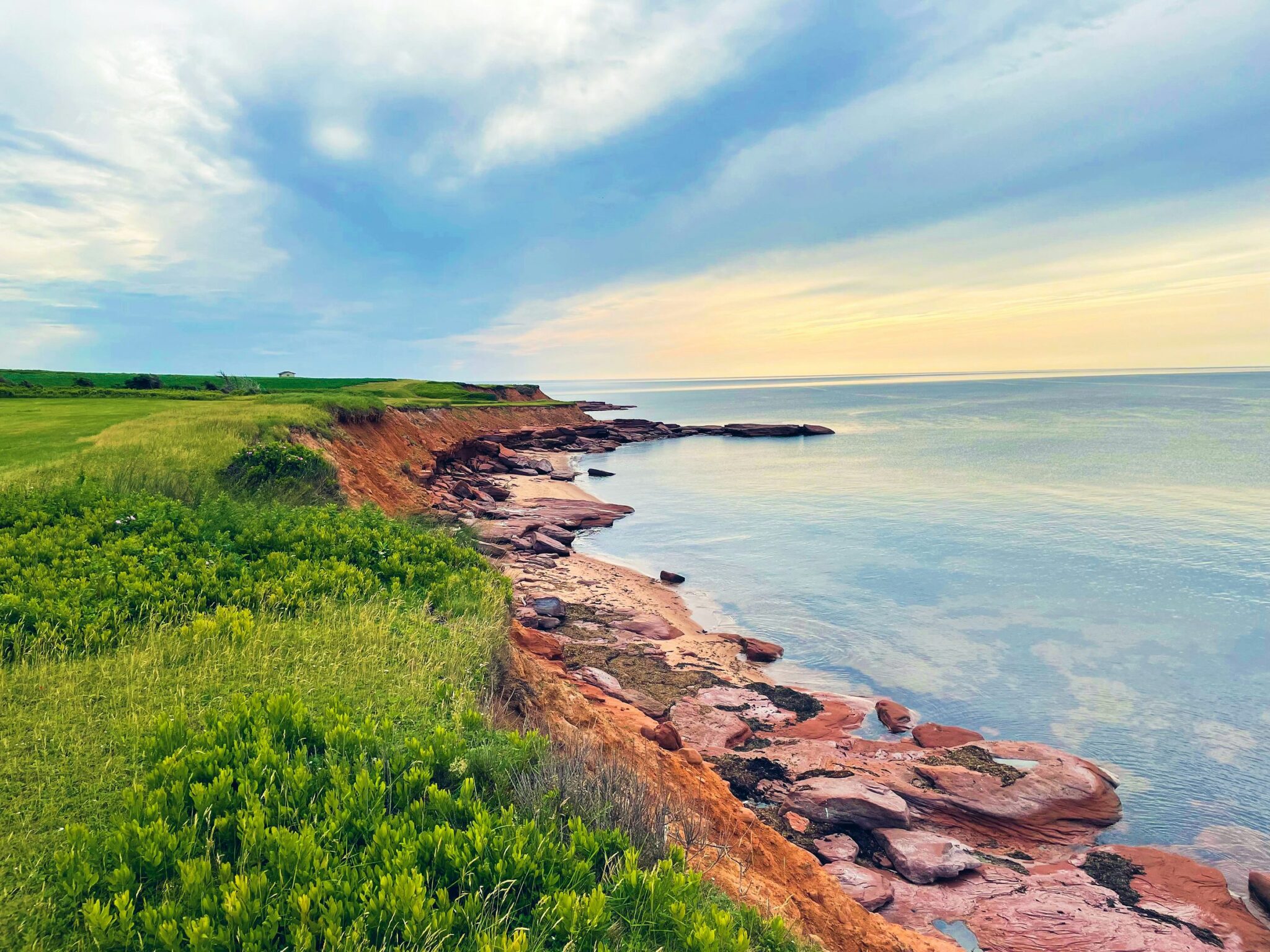
In just 90 minutes the ferry crosses from Nova Scotia to Prince Edward Island. Canada’s smallest province feels a world away from everyday life. Stepping ashore, you arrive on an island once called Epekwitk. That’s what the Mi’kmaq, the First Nation of this region, called their home, a name often rendered as “Cradled on the Waves”. And that calm is tangible everywhere. Nothing seems rushed, everything runs slower, more relaxed, almost idyllic.
You sense it immediately in Montague, our first stop. A small seaside inn with a country singer in the garden — and an older couple who simply can’t sit still, slipping into perfect jive steps between the tables again and again. The whole terrace lights up.

A green paradise: Greenwich National Park
A trip to Canada feels incomplete without visiting a national park — there are 37 parks and 11 reserves to choose from. One of them is Greenwich on Prince Edward Island, known for its “green dunes”. The path first winds through dense woods before a floating boardwalk signals the shift into an open, almost surreal landscape. The crescent-shaped dunes are covered in marram grass whose roots hold the sand in place and give it that characteristic greenish tone.
And beyond nature, the island offers stories with real human weight. One comes from Barbara and Thomas, a Swiss-German couple who fulfilled their dream of running their own guesthouse in 2020 despite the pandemic: 45 Steps — The Culinary Beachside Inn. “This house is a labour of love for both of us, a dream come true,” Barbara says.
Climate change, up close
PEI has far more to offer than postcard calm. On the island, the Canadian Centre for Climate Change and Adaptation works to make climate impacts tangible. We meet Ross. “Twenty years ago, Maine was the undisputed centre of lobster fishing,” he says. “But as the ocean has warmed, lobsters have moved farther north. Now southeastern Canada has become a new hotspot.”
What initially looked like an economic win could soon turn into its opposite: if the trend continues, stocks could keep shifting into cooler northern waters, taking one of the island’s most important income sources with them. Similar pressures show up on land, where potato farming suffers under rising temperatures and the pests that come with them. The institute works with farmers on better-suited varieties. Science doesn’t happen in an ivory tower here, but in exchange with farmers, fishers and communities.
Mi’kmaq: First Nations in focus
No one is more deeply tied to this island than the Mi’kmaq. For them, Prince Edward Island has been home for millennia. They maintained trade relationships with French settlers in Acadia; when the British took over the region in 1713, the loss of land and rights began. While the Acadians were expelled, the Mi’kmaq had to navigate missionization, dispossession and discrimination.
Today, Mi’kmaq voices are rising again. On Lennox Island and within the Abegweit First Nation, schools, cultural programmes and economic initiatives are taking shape, the language Mi’kmawi’simk is taught in courses, children are learning traditional songs again. At the same time, communities continue to face unemployment, limited access to health services and ongoing land-rights questions. The outlook stays forward-facing: “We have not disappeared,” says Chief Thabata on Lennox Island. “We are still here, and we are shaping our future ourselves.”
Charlottetown: birthplace of Canada
In Charlottetown, the island’s capital, the groundwork for modern Canada was laid. In September 1864, representatives from Nova Scotia, New Brunswick, PEI and the then-Province of Canada met at the Charlottetown Conference to discuss a possible union. What began as a regional project quickly became a vision for a federal state.
But what truly put Charlottetown on the global map isn’t constitutional history — it’s a red-haired orphan: Anne Shirley, from Lucy Maud Montgomery’s “Anne of Green Gables” (1908). Canada’s “Heidi” has long since turned into a thriving merchandising market: chocolate, potato chips, sugar fudge, plush toys, tea, puzzles, everything comes with an Anne label. One highlight for fans is the Dalvay-by-the-Sea hotel, which served as the “White Sands Hotel” in an Anne adaptation: a grand Victorian manor whose lounge with its plush armchairs practically demands scones and tea.
After ten days along coasts, forests and dunes, between lobster fishers, winemakers and storytellers, we take stock. Everywhere they appear, those iconic Muskoka chairs — on verandas, on beaches, in bright colours. They invite you to sit, rest, watch and think. Just like Canada itself: an invitation to feel nature and to experience people’s stories. A place that stays with you.
Information
Getting there — Edelweiss operates seasonal nonstop flights from Zurich to Halifax: flyedelweiss.com
Where to stay in Nova Scotia — Sutton Place Hotel in Halifax, Black Forest Cabins in Mahone Bay, Argyler Lodge in Glenwood, Seek Wilderness in Truro
Where to stay on Prince Edward Island — Rodd Brudenell River Resort in Cardigan, 45 Steps in St. Peter’s Bay, Dalvay-by-the-Sea in York, The Great George in Charlottetown
Where to eat — The Lobster Pound in Hall’s Harbour, Betty’s at the Kitch in Mahone Bay, Sims Corner in Charlottetown. Book ahead everywhere.
Good to know — Nova Scotia and PEI are sparsely populated and internet coverage isn’t always reliable. Download offline maps while on Wi-Fi.
Words: Brigitte and Hannes Huggel